Oct 21, 2026Pet Feeder Wholesale Guide
Low MOQ Pet Feeder: How to Test a Market with 100 Units
How to test a market with 100 units, calculate landed cost, structure mixed-model orders, customize packaging and spot red flags in low MOQ pet feeder deals.
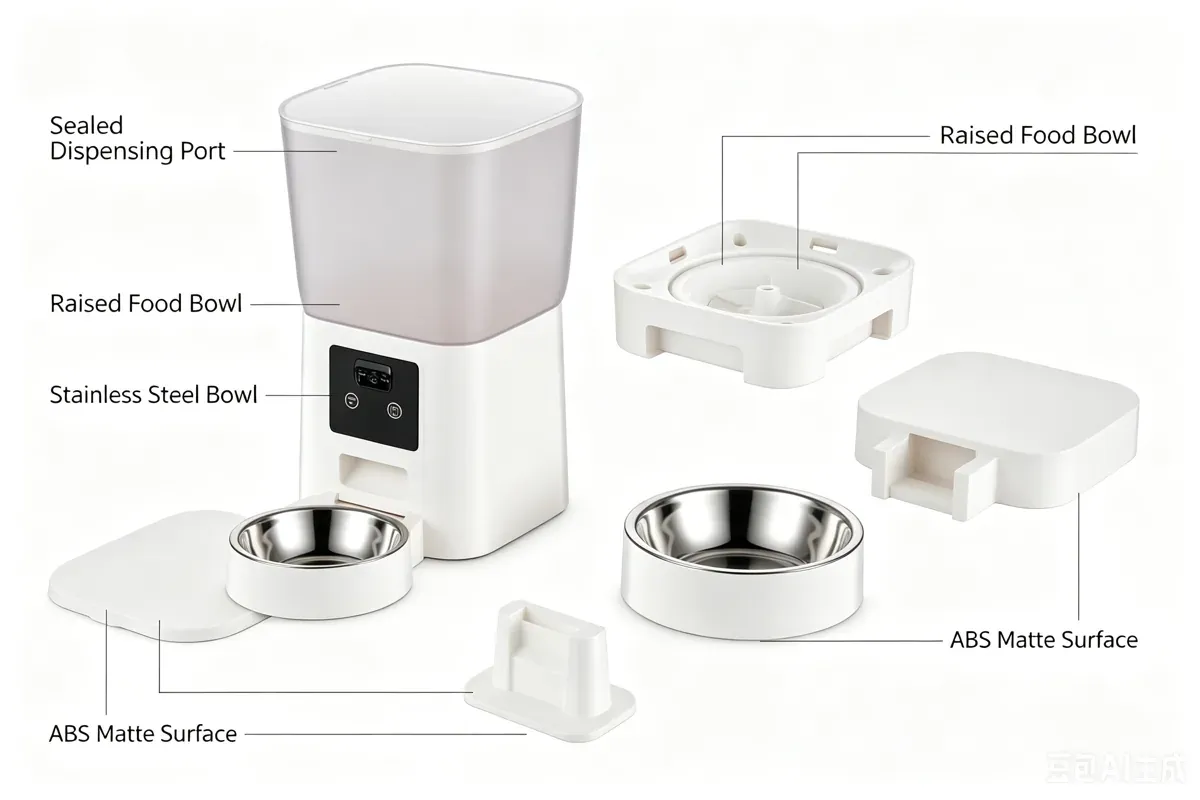
A low MOQ pet feeder order is a market test, not a smaller version of a container order. The goal is to learn whether a model sells, what it costs to land and what breaks in support before committing to a larger run. That changes how you choose the SKU, the packaging and the supplier.
This guide explains how to test with 100 units, how to build a landed-cost model, how mixed-model orders work, what can be customized at low volume, and the red flags to avoid.
Why a Low MOQ Pet Feeder Order Is a Real Test
MOQ 100 units per model is low enough to limit inventory risk and high enough to test a retail listing, a small distributor route or a shelter contract. It is not a sample order. At this volume you will see carton quality, label consistency and after-sales questions.
Treat the first 100 as a data purchase. Define what you want to learn before the order: sell-through at a price point, return reasons, assembly time, packaging damage or whether the app is manageable for your customers. A test without a question becomes inventory.
What 100 Units Can and Cannot Prove
• Can prove — Cannot prove
• Sell-through at a specific price — Long-term motor life
• Packaging survival on your lane — Seasonal demand
• Setup and support load — Certification for future models
• Basic unit-to-unit consistency — Full-market price elasticity
• Whether reorder demand exists — Container-level economics
The first order is a signal, not a verdict. If 100 units sell through and returns stay manageable, you have a reason to plan a larger order. If they do not, you have learned that at a controlled inventory cost.
Landed Cost Components
Build the model per unit, not per order. Include:
• Unit price at the agreed Incoterm, and what it includes.
• Export packaging and labeling.
• Inland freight to the port and origin charges.
• International freight, insurance and any transshipment.
• Duty, taxes and customs clearance.
• Port, terminal and last-mile delivery.
• Payment fees and currency conversion.
• Damage allowance and returns reserve.
• Certification, testing and sample costs.
• Listing, photography and marketing costs.
Use a range for freight rather than a single quote. Freight changes, and a landed-cost model that assumes one rate will mislead the pricing decision.
Mixed-Model Orders: What 100 Actually Means
MOQ applies per model, not per order. A 100-unit mixed order can include several models only if each model meets its own 100-unit minimum. If a supplier offers 100 units total across five models, confirm whether that is a stock-assortment allowance or a genuine MOQ.
Mixed orders are useful for testing bowl configuration, color or button versus WiFi within one model family. Keep the number of SKUs small enough to track sell-through. Too many variants with 100 units each turns a test into a warehouse.
A practical first order is one or two models with a clear price gap or a clear use-case difference. For example, a 5 L button feeder for price-sensitive retail and a 5.5 L button model for households that want fewer refills. Product pages such as the Budget 5L and CW-W2409 Button show the specification differences to test.
Packaging and Label Customization at Low Volume
At 100 units, expect stock packaging and limited labeling. Custom printed cartons, branded manuals and retail-ready designs usually sit with OEM from 500 or ODM from 2,000.
Confirm what is included at each tier: logo on the unit, sticker on the carton, insert, manual language, barcode and retailer label. Do not assume custom packaging is available or free at 100 units. Ask for a written breakdown of tooling, print setup, minimum print run and lead time.
For the first order, keep packaging simple and use the test to learn what the shelf needs. A clean stock carton with correct labeling is easier to evaluate than a custom design with a long lead time.
Sample vs Bulk: What to Compare
The sample answers questions about function and finish. The bulk order answers questions about consistency.
• Sample: function, bowl fit, noise, app pairing, cleaning access.
• Bulk: unit-to-unit consistency, carton condition, label accuracy, manual language and accessories.
• Production check: portion weight, outlet alignment, carton count and certificate model list.
Ask for a production unit from the same line, not a hand-built sample. If the sample and the bulk order differ, the sample is not a reference.
Launch Plan for the First 100
1. Choose one or two models with a clear customer and price position.
2. Confirm the landed cost, including freight and duty, before setting the retail price.
3. Order stock packaging with correct labels and a manual in the target language.
4. Photograph the actual production unit, not a supplier image.
5. List the product with the limits stated: dry kibble 3–18 mm, battery backup about six hours, adapter and batteries not included.
6. Track sell-through, returns, support questions and damage reports.
7. Set a reorder trigger based on remaining stock and the lead time of 7–30 days.
This plan keeps the first order focused on learning rather than on a full brand build. For OEM/ODM scope, see solutions. For the full sourcing framework, read the wholesale buying guide; for control-type selection, see WiFi vs button control.
Red Flags in Low MOQ Deals
• [ ] MOQ quoted as 100 units total across an unlimited number of models.
• [ ] A price far below the category with no explanation of component changes.
• [ ] A certificate pack with no model list.
• [ ] No spare bowls, motors or adapters available.
• [ ] Adapter or batteries described as included when the specification says otherwise.
• [ ] A vague lead time with no production schedule.
• [ ] Packaging dimensions or carton quantity that differ from the spec sheet.
• [ ] No written defect and returns process.
• [ ] Pressure for full payment before production.
• [ ] No clear answer on which model the certificate covers.
FAQ
Is 100 units enough to test a market?
Yes, for a limited channel such as a small distributor, a single store or an online listing. It is not enough to prove national retail demand or long-term durability. Use it to test sell-through, support load and packaging.
Can I mix models to reach the 100-unit minimum?
MOQ is per model. You can order several models in one shipment, but each model needs to meet its own minimum. Confirm the rule in writing before you build the assortment.
What does OEM 500 include?
OEM starts at 500 units. The exact scope depends on the model and the customization: logo, packaging, manual and app options. Request a written specification and quotation rather than assuming a package.
How long does a low MOQ order take?
Standard models have a lead time of 7–30 days. Custom orders are quoted separately. Add production, inspection, freight and customs time to the plan.
What should I order first?
One or two models with stock packaging and a clear price or use-case difference. Confirm the landed cost, list the product with accurate limits, and track returns before expanding the range.
Conclusion
A low MOQ pet feeder order works as a structured test: one or two models, a landed-cost model, stock packaging and a clear list of what you want to learn. The 100-unit minimum per model limits risk without turning the order into a sample. Check the commercial terms, the certificate coverage, the spare parts and the packaging before you pay. If the test sells through and the support load is manageable, you have the evidence for a larger order. If it does not, you have protected the business while learning the market.