Aug 18, 2026Buying Guides
WiFi vs Button Control Pet Feeder: Which Should Your Customers Choose?
Choosing between WiFi smart pet feeders and button-control timer feeders? This guide compares app control, reliability, price, and best-use scenarios, with Premium Paw model recommendations for each c


WiFi vs Button Control Pet Feeder
WiFi vs Button Control: The Big Question Every Buyer Asks
If you're sourcing automatic pet feeders for your store or distribution business, you've probably noticed something: every model comes in two flavors — WiFi/app-controlled and button/timer-controlled. And every buyer asks the same question: which one is actually better?
Here's the honest answer: neither is universally better. They serve different customers, different living situations, and different budgets. After selling over 50,000 feeders across 20+ markets, we've learned that the most successful distributors carry both types — and match each one to the right customer.
This guide breaks down exactly who needs WiFi, who's better off with buttons, and what the real differences mean for your bottom line.
[H2] Who Should Choose a WiFi Smart Pet Feeder?
What WiFi Feeders Actually Do?
A WiFi pet feeder connects to your home network and pairs with a smartphone app — in our case, the Tuya Smart app. That means the owner can:
- Set and adjust feeding schedules from anywhere
- Dispense a meal manually with one tap
- Receive low-food alerts on their phone
- Check feeding history and portion accuracy
- On camera models like the CW-W2510, see and talk to their pet in real time
The key word here is "remote." A WiFi feeder isn't just a timer — it's a connected device that gives the owner control even when they're at work, on vacation, or stuck in traffic.
Who WiFi Feeders Are Really For?
WiFi feeders aren't for everyone, but they're perfect for these customers:
- Working professionals who are out of the house 8-12 hours a day and want to adjust feeding times on the fly
- Tech-savvy younger owners (18-35) who expect everything to work with their phone — and will pay more for it
- Multi-pet households where feeding schedules change and remote monitoring saves time
- Frequent travelers who want to check that the feeder actually dispensed the meal
- Customers in areas with stable, reliable internet — this is non-negotiable
In our experience, WiFi models account for roughly 45-55% of feeder sales in developed markets like North America and Western Europe, where internet penetration is high and smartphone ownership is near-universal.
Recommended WiFi Models from Premium Paw
Model | Capacity | Key Feature | Best For |
|---|---|---|---|
5L | Camera + two-way audio | Premium market, pet owners who want to watch their pet | |
5L | App control, no camera | Volume seller, cats and small dogs | |
6.5L | Large capacity, app control | Medium dogs, multi-pet households | |
5.5L | Mid-size, app control | Single pet, apartment living |
The CW-W2401 is our best-selling WiFi model — it hits the sweet spot between features and price, and the 5L capacity works for most cats and small dogs.
Who Should Choose a Button-Control Timer Feeder?
What Button-Control Feeders Actually Do?
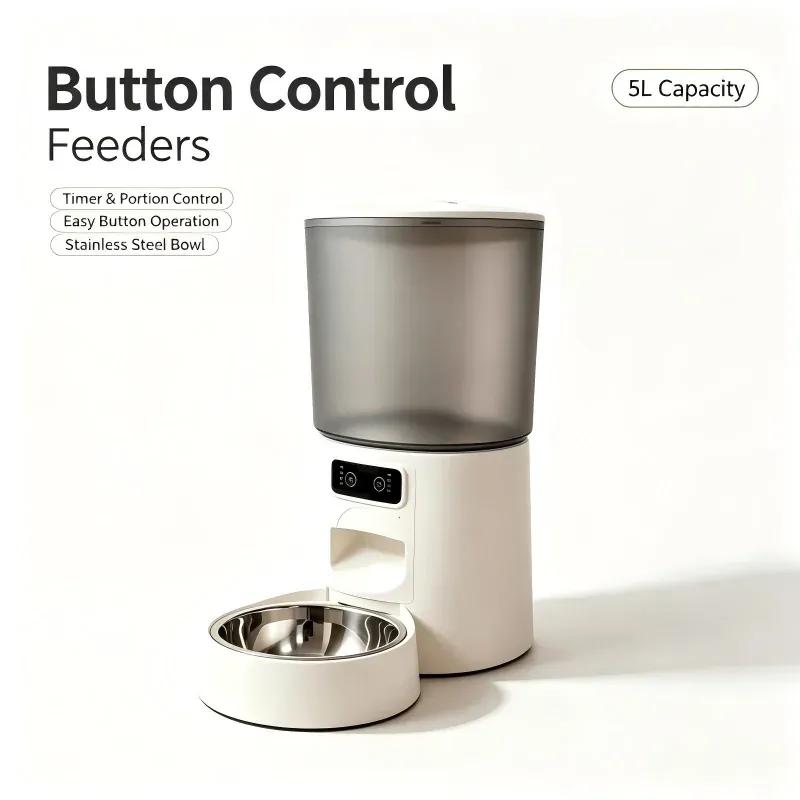
A button-control feeder has no WiFi, no app, no account to set up. You program the feeding schedule directly on the device using physical buttons — usually 3-4 large buttons on the front or top. Once set, it runs independently on either AC power, batteries, or both.
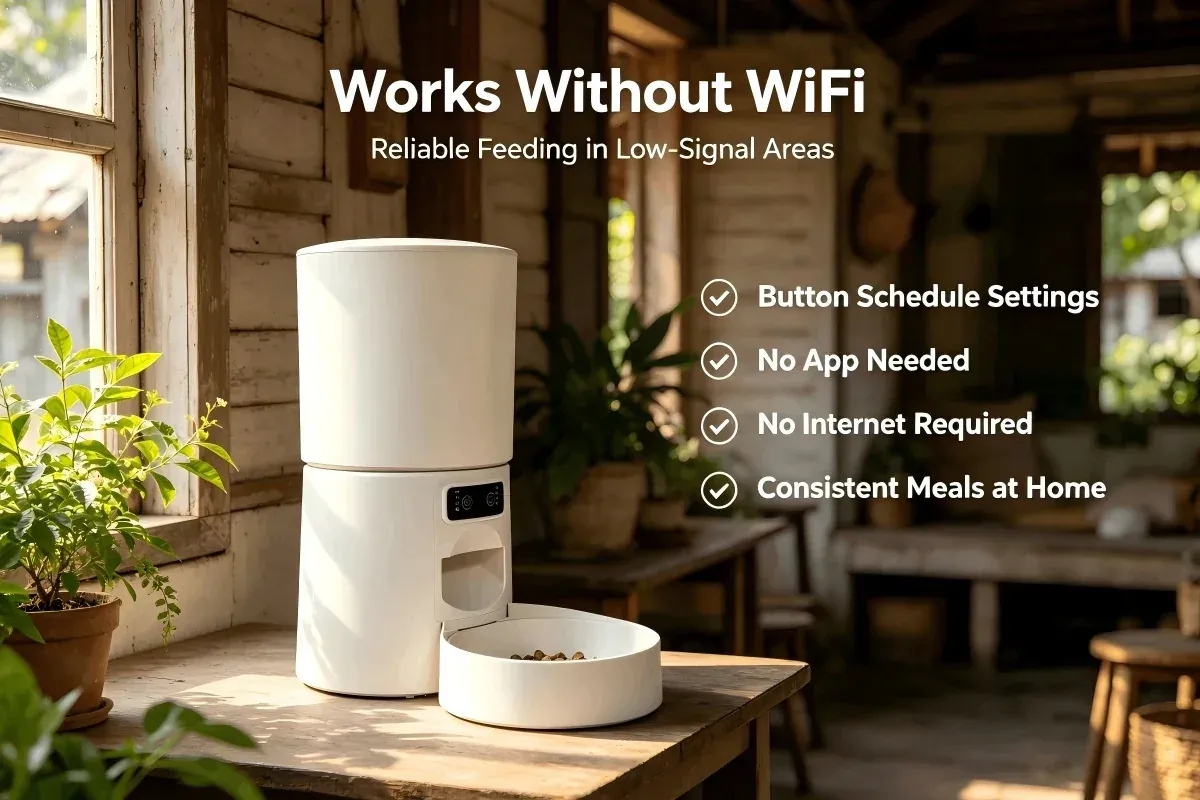
That's it. No smartphone required. No WiFi password to enter. No firmware updates.
Who Button Feeders Are Really For?
Don't make the mistake of thinking button feeders are "cheap" or "low-end." They're the right choice for a lot of customers:
- Seniors and less tech-savvy owners who find smartphone apps confusing or frustrating
- Customers in areas with unstable internet — rural regions, shared apartments, developing markets where WiFi drops out daily
- Budget-conscious buyers who want reliable automatic feeding without paying for features they won't use
- Second-home owners who want a feeder at a vacation property with no WiFi
- Gift buyers who don't know the recipient's WiFi password and want something that works out of the box
Here's a data point that surprises people: in Southeast Asia, rural Eastern Europe, and parts of Latin America, button-control feeders outsell WiFi models by roughly 2-to-1. It's not about being "behind" — it's about what actually works reliably in those markets.
Recommended Button-Control Models from Premium Paw
Model | Capacity | Key Feature | Best For |
|---|---|---|---|
5L | Simple buttons, battery backup | Budget market, cats and small dogs | |
6.5L | Large capacity, key buttons | Multi-pet, medium dogs | |
5.5L | Single bowl, no WiFi | Single pet, no-internet areas | |
3.5L | Smallest size, lowest price | Travel, small apartments, gift market |
The CW-W2401 manual version is identical in build quality and anti-jam design to its WiFi sibling — it just skips the app module. That's important: button control doesn't mean lower quality.
Side-by-Side: The Real Differences
Feature | WiFi Smart Feeder | Button-Control Timer |
|---|---|---|
Setup time | 5-10 minutes (app + WiFi) | 2 minutes (buttons only) |
Remote control | Yes, from anywhere | No, must be at the feeder |
Scheduled feeding | Yes, via app | Yes, programmed on device |
Low-food alert | Phone notification | Indicator light on feeder |
Feeding history log | Yes, in app | No |
Camera option | Yes (CW-W2510) | No |
Works without internet | Schedule continues, but no remote access | Yes, fully independent |
Power options | AC + battery backup | AC + battery (some models battery-only) |
Price level | Mid to premium | Budget to mid |
Typical unit cost difference | Base price | 30-40% lower than equivalent WiFi model |
Return rate | Slightly higher (app setup confusion) | Lower (simple, reliable) |
A common mistake we see: buyers assume WiFi feeders are "more advanced" and therefore better for everyone. But if your customer lives in an area where the internet goes out twice a week, a WiFi feeder becomes an expensive paperweight for remote functions — the schedule still runs, but they lose the features they paid extra for.
The Real Cost Difference (and Why It Matters for Distributors)
Let's talk numbers, because this is where stocking decisions get real.
An equivalent WiFi model typically costs 30-40% more per unit than its button-control counterpart. For example, our CW-W2401 WiFi and CW-W2401 manual use the same housing, same motor, same anti-jam outlet, same stainless steel bowl. The only difference is the WiFi module and app integration — and that adds real cost.
But here's what matters: WiFi models carry higher margins. Customers expect to pay more for smart features, and the retail price gap is usually wider than the wholesale cost gap. A WiFi feeder that costs you 10-15 more at retail.
However, button models have their own advantage: lower return rates and fewer support tickets. App setup issues account for the majority of feeder returns and customer service inquiries. Button feeders? People plug them in, set the time, and they just work.
For distributors, the smart play is usually both:
- WiFi models for higher margins and premium positioning
- Button models for volume, reliability, and markets where WiFi isn't dependable
What Distributors Should Actually Stock
Based on what works for our most successful partners, here are three stocking strategies:
Option 1: New seller, limited budget
- 1 WiFi model: CW-W2401 5L (the volume seller)
- 1 button model: CW-W2401 5L manual (the budget counterpart)
- Total: 2 SKUs. Same capacity, same look, two control types. Easy to explain to customers.
Option 2: Established seller, balanced range
- 1 premium WiFi: CW-W2510 with camera (high margin, marketing-friendly)
- 1 mid WiFi: CW-W2408 6.5L (for dog owners and multi-pet)
- 1 button: CW-W2408 6.5L manual (budget large-capacity option)
- Total: 3 SKUs. Covers premium, mid, and budget.
Option 3: Full-range distributor
- All WiFi models (CW-W2510, CW-W2401, CW-W2408, CW-W2409, 3.5L)
- All button models (CW-W2401 manual, CW-W2408 manual, CW-W2409 manual, CW-W2409LD)
- Total: 9 SKUs. Maximum coverage, but requires warehouse space and inventory management.
To be honest, Option 1 is where most new sellers should start. Two SKUs, same form factor, easy to market as "WiFi or simple timer — your choice."
FAQ
Q: If the WiFi goes out, does the feeder stop feeding?A: No. Once a feeding schedule is set in the app, it's stored locally on the feeder itself. The schedule continues to run even without WiFi. What you lose is remote control, camera access, and phone notifications. For customers in areas with frequent outages, this is exactly why the button model might be the better choice.
Q: Can I set the same schedule on both WiFi and button models?A: Yes. Both support multiple daily meals with portion control. The difference is how you set it — app vs. buttons — and whether you can change it remotely.
Q: Which type has more warranty claims?A: In our experience, WiFi models have slightly more service inquiries, mostly related to app connectivity and WiFi setup. The mechanical parts (motor, auger, outlet) are identical across both types and have the same failure rate. Button models tend to have fewer overall support tickets because there's less to go wrong.
Q: Do button feeders work with batteries only?A: Most of our button models support both AC adapter and D-cell battery backup. The CW-W2409LD compact model can run on batteries alone, making it suitable for travel or locations without a nearby power outlet.
Q: Should I only sell WiFi feeders because they're "the future"?A: We'd advise against it. Even in highly connected markets like Germany and the US, 30-40% of feeder buyers still choose button control — often for elderly pets owners, rental properties, or simply because they don't want another app on their phone. Ignoring that segment leaves money on the table.
Ready to Choose?
The WiFi vs button question isn't about which technology is better — it's about which customer you're serving. WiFi feeders offer convenience, remote control, and premium features for connected households. Button feeders offer simplicity, reliability, and affordability for everyone else.
At Premium Paw, we build both types to the same quality standard: food-grade materials, anti-jam outlets, stainless steel bowls, and strict factory QC. The control method is the only real difference.
Browse our full WiFi pet feeder collection or explore button-control timer feeders to compare models side by side. If you're a distributor looking for the right assortment for your market, contact our sales team — we'll recommend specific models based on your region, customer demographics, and budget. We typically reply within 24 hours.
Still not sure which type fits your market? Tell us where you're selling and who your customers are. We'll share real sales data from similar markets to help you decide.